|
March 23 - World Meteorological Day
The World Meteorological Day is celebrated every year to commemorate the entry into force on 23 March 1950 of the Convention of the World Meteorological Organization (WMO) and the significant contribution that national hydrometeorological services make for the security and well-being of society. The Republic of Moldova has been a member of WMO since 1994 and actively participates in its activities. Currently, WMO includes 191 countries.
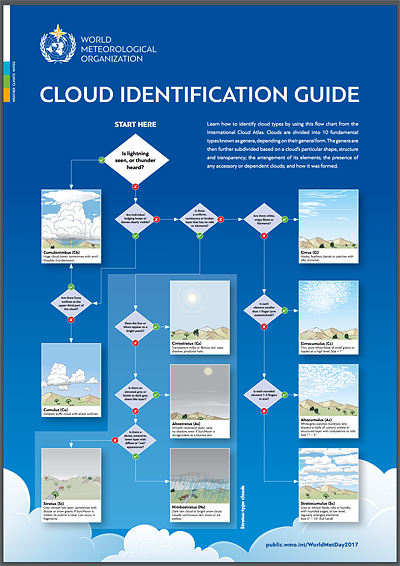
On the World Meteorological Day, a new edition of the International Cloud Atlas has been published, which has undergone the most thorough and detailed processing for the entire long and outstanding history of its existence. The new WMO Atlas is a treasure trove containing hundreds of images of clouds, including several recently classified cloud types. It also reflects other meteorological phenomena, such as the rainbow, halo, tornadoes and hail. Atlas has been prepared for the first time in a digital format and is available via both computers and mobile devices.
On the territory of Moldova, systematic observations of cloudiness, at meteorological stations, are mostly done for about 70 years, which made it possible to study the regime of cloud cover over a long period.
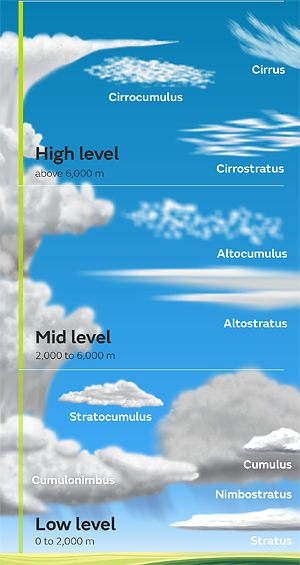
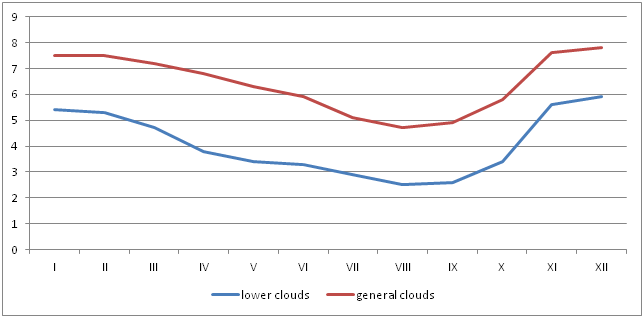
To the general cloudiness, it is customary to include clouds of all tiers, to the bottom - only the clouds of the lower tier. Forms of clouds are determined by appearance in accordance with the accepted classification of clouds. Currently, when defining the forms of clouds, their species and varieties, meteorologists are guided by the International Cloud Atlas, ed. 1987. In Moldova, the average long-term cloudiness regime is formed under the influence of circulation processes that determine the prevailing direction of air masses and their moisture content, and under the influence of the action of the underlying surface. On the territory of Moldova, given its small area, the spatial variability of all cloud characteristics is insignificant. Cloudy weather in Moldova is observed mainly from November to March (Fig. 1). Points
Fig.1 Amount (points) of the general and lower clouds. Chisinau
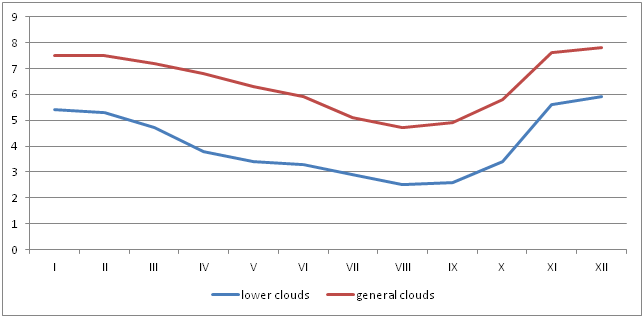
The repeatability of the cloudy sky at this time in Chisinau is 65-80% for total cloud cover and 45-55% for lower cloud cover (Fig.2).
Fig.2 Repeatability (%) of the sky state in the lower cloud cover. Chisinau
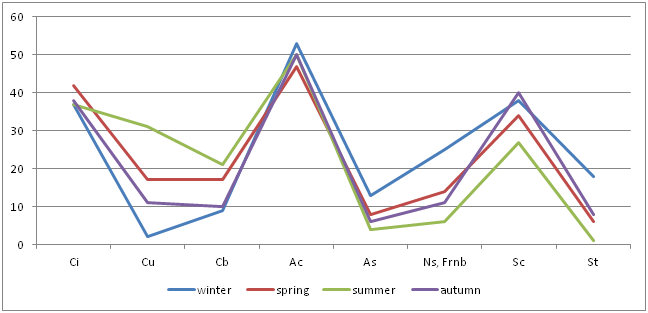
On the territory of Moldova on average per year are observed from 79 to 150 clear days and from 44 to 74 cloudy days. However, in some years their number may increase in the territory to 208 clear days (1993) and 133 cloudy days (1984) respectively. The largest number of clear days in the average observed in August-September (20-28 days), cloudy - mostly in November (21-26 days). The average number for the year of cloudy days (in the lower clouds) during the year varies from 44 to 74 days Shapes of clouds, depending on the time of year vary considerably (Figure 3). %
Fig. 3. Repeatability (%) of the main forms of cloud cover by season. Chisinau
In the cold season, at low air moisture content and the presence of surface inversions, mainly predominate stratiform clouds. In the warm period of the year, a continuous cloud cover is rare, as a rule, only with the passage of fronts. Basically at this time there are clouds of vertical development. Understanding the forms of clouds, their evolution, for a long time were the basis for compiling a weather forecast. By some forms of clouds, one can predict the weather conditions. So, the clouds Сu hum. (Photo 1) are signs of good weather.
Photo 1. Cumulus humilis flat clouds (Сu hum.)
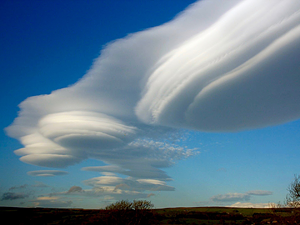
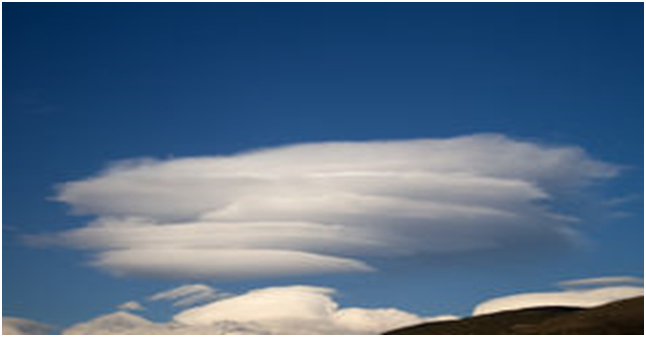
Clouds Aс lent. (Photo 2) are precursors of the passage of the cold front.
Photo 2. High cumulonimbus clouds (Aс lent.)
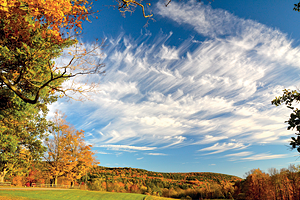
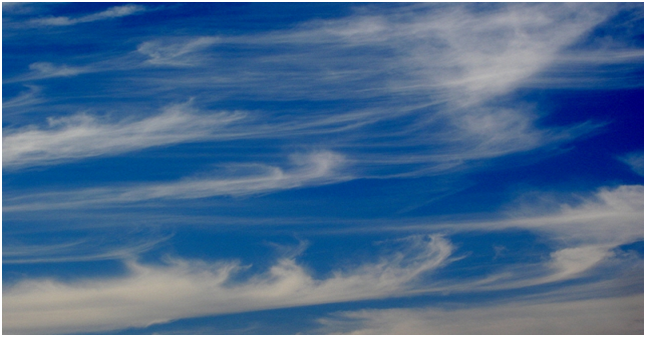
Clouds Ci unc. (Photo 3) are forerunners of the warm front.
Photo 3. Pinnate clawed clouds (Ci unc.)
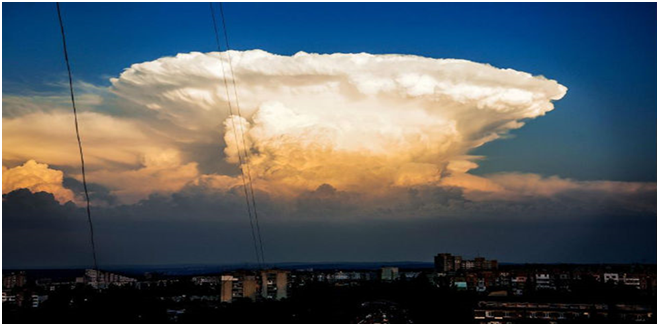
Of all kinds of clouds, the most dangerous phenomena are caused by cumulonimbus clouds (Cb inc.), containing a huge amount of water (Photo 4). In Moldova, their frequency in the winter and autumn periods is about 10%, in spring and summer - twice as much. They can cause severe downpours, thunderstorms, lightning, hail, icing of airplanes, damage to communication lines and power lines.
Photo 4. Cloud cumulonimbus hairy with an anvil (Cb inc.)
It should be noted that the WMO theme "Understanding the clouds" draws attention to the clouds, our life companions. It allows you to appreciate their diversity, impact on a person's mood. It is no accident that the aesthetic appeal of clouds throughout history inspires artists, poets, musicians, and photographers to create beautiful works. For meteorologists, the updated International Cloud Atlas developed by WMO in digital format will help to better determine the shape of the clouds, their evolution, and therefore improve the quality of forecasts.
|